

(Image retrieved from: beverageuniverse.com)
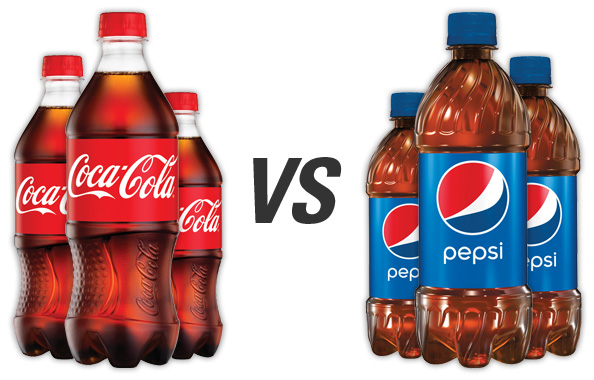
Watching the YouTube video “Top 10 Business Rivalries” by WatchMojo.com, we can find a series of well-known companies that are always competing to be the first place, for example Coca-Cola and PepsiCo. Coke is the leader or “top dog” in the market of soda, not only in the United States, but around the planet. The closest competitor, or “underdog,” is Pepsi. Coca Cola does not target just one certain segment, rather it adapts its products to the population.
Since Coke sells 80% of its products outside of the United States, there are many target markets, and so the branding varies by location (Bhasin, 2017, p.1). Coca Cola sells many products in addition to its flagship product. It considers its market to be any human consumption of a liquid. Therefore, it is competing even with water (Daye, 2007, p.1). Pepsi was formed as a direct competitor to Coke from the beginning. Since its inception, Pepsi has always targeted the youth segment (“Branding Strategies,” 2018, p.1). For example, in India, Pepsi focused on two of the biggest obsessions of the Indian youth – Cricket and Bollywood – to design its advertisement campaigns (“Branding Strategies,” 2018, p.1) Pepsi differentiates itself from Coke also by the taste; it is sweeter than Coke. The main brand strategy of Coke is simply having brand accessibility to everyone. It means Coke tries hard to reach every target segment. Another strategy used by Coke is to appeal to emotion. For example, they promote the idea that Coke is fun. Or, they promote diversity. Many advertisements show different races of people all enjoying a Coke. On the other hand, Pepsi’s strategy is to paint Coke as being for the old generation, while Pepsi is for the new generation. The other strategy is to focus on the taste of Pepsi as being superior. It is sweeter and tastes better.
Underdog brands are effective in the marketplace because consumers identify disadvantage position of the underdog and share their passion and determination to succeed when the odds are against them (Lagace, 2010).
 (Image retrieved from: https://designshack.net/articles/graphics/pepsi-vs-coke-the-power-of-a-brand/)
Recommendations to Pepsi to improve its strategy and gain more market share and surpass the top dog are: First, use more digital marketing and social media, which are the main channels to reach the Millennials. Take advantage of events like the Super Bowl and other popular events to capture their attention. For example, the last commercial of PepsiCo Company, “Mountain Dew vs. Doritos,” has been a success. Second, sign more agreements with fast-foods and restaurants to serve its products. Pepsi is found for example, in some restaurants like Panera Bread, IHOP, KFC or Pizza Hut. But there is still more to do. Third, sell “emotions” like Coke does a lot, to make consumers believe it is the best product. For example, use commercials that feature a family Christmas scene, a party in a beach with friends, or people having fun playing in a park. These commercials could feature people of various ages in order to touch people’s feelings in a stronger way. Try to associate their product with having a good time.

(Image retrieved from: http://www.businessinsider.com/strategies-coca-cola-used-to-become-a-famous-brand-2015-6)
I believe some consumers prefer the top dog over the underdog for different reasons. Coke surpasses Pepsi because of its status as the first, the original, and therefore the better cola drink. Coke has been distributed worldwide longer than Pepsi. “Coca Cola” is the second most-used universal word after “OK.” I believe that Coke’s marketing to families (and all people) rather than just focusing on youth as Pepsi has done, has been its key to success and being the top dog. Coke seems to know that Mom does the shopping and to get her you have to use an emotional appeal that makes Coca-Cola not only something that the whole family desires, but something that is literally an integral part of the family’s life experiences (Johnson, 2011, p.1).
The top dog is a bigger company and has enough resources to invest in big advertising campaigns and pay for a large Marketing team. Visual elements are used to start capturing consumers’ attention. Colors, audio, and verbal messages are some elements used to make people curious about what the company wants to sell. Then the innovation and creativity they put into their products make a difference. Top dogs are always thinking of new ways to renew themselves. For example, they show modern and nice-looking products. Also, the support of artists and well-known people can boost a product. The quality of a product as well as the price are reasons for a consumer to find some brands top dogs over others.
What do I prefer, “the top dog or the underdog”? In relation to Coke and Pepsi, Coke could be a top dog brand, but I am not a soda person.
Since an early age, I practiced ballet and my dance teacher prohibited my classmates and me from consuming soda because it makes people gain weight. Later, when I grew up I became accustomed to not drink it. Sometimes, in some parties when I have no option, I will drink whatever cola is available. In sum, I have no preference between them.
But, I understand that most people will like one or the other depending on different factors. Coke did a good job branding its soda. And as years pass, they accumulate more experience how to reach their targets.
References
Bhasin, Hitesh (2017). Marketing Strategy of Coca Cola – Coca Cola Marketing Strategy.
Marketing 91. Retrieved from:
https://www.marketing91.com/marketing-strategy-of-coca-cola/
Branding Strategy of Pepsi (2018). Retrieved from:
http://ideasmakemarket.com/2012/03/ideasclash2-0-entry12-branding-strategy-of pepsi.html
Daye, Derrick (2007). Brand Spotlight: Coca-Cola. Brand Strategy Insider. Retrieved from:
https://www.brandingstrategyinsider.com/2007/04/brand_spotlight.html#.WspXwmfrsSk
Johnson, Joshua (2011). Design Shack. Retrieved from:
https://designshack.net/articles/graphics/pepsi-vs-coke-the-power-of-a-brand/
Lagace, Martha (2010). The Consumer Appeal of Underdog Branding. Working
Knowledge. Harvard Business School. Retrieved from:
https://hbswk.hbs.edu/item/the-consumer-appeal-of-underdog-branding
WatchMojo.com (2014). Top 10 Business Rivalries. YouTube. Retrieved from:
“https://www.youtube.com/watch?v=1OE4Q60Dzyw
Wiener-Bronner, Danielle (2018). Why Coke is Winning the Cola Wars. Retrieved from:
http://money.cnn.com/2018/02/20/news/companies/cola-wars-coke-pepsi/index.html
 EK Marketing Blog by Ericka Koehler